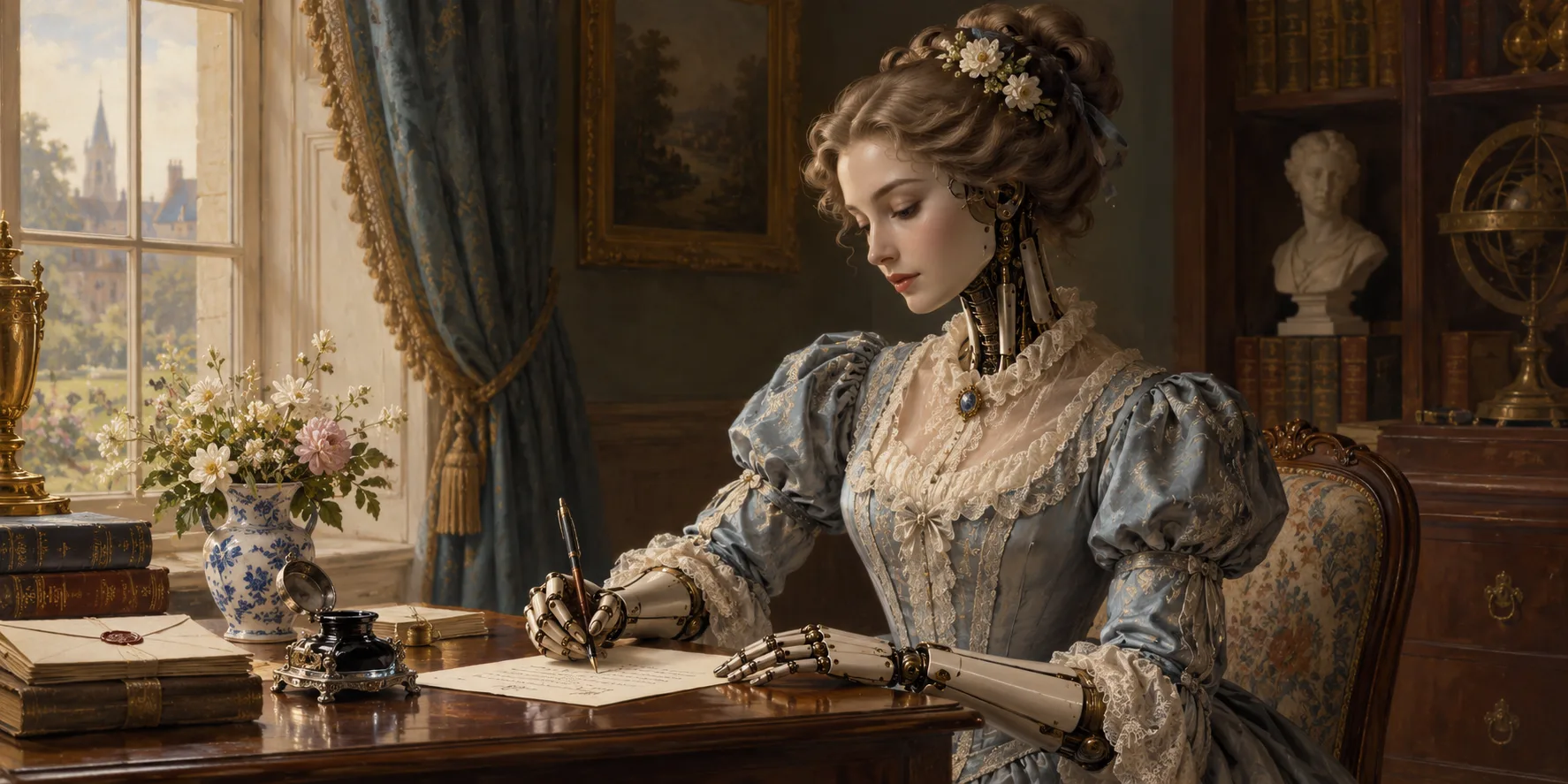
A Second Pair of Eyes That Doesn't Get Tired
My dear reader,
I write to you today on a subject that will be, I think, immediately familiar to any novelist who has ever reached chapter nineteen and wondered, with a creeping unease, what colour she said the heroine's eyes were in chapter three.
The answer, I find, is almost never the one you expect.
A long manuscript is a world unto itself, and a world of some complexity. It has its rules: the ones the story states plainly, and the ones it implies by what it shows. Characters have histories and names and particular ways of speaking. Timelines run in one direction, and are not generally permitted to double back without good reason. A detail established in the opening pages may lie quietly for two hundred more before it is called upon again, and by then, the author who placed it there may have quite forgotten it.
Revision makes this worse, not better. One moves a scene. One changes a name. One resolves a plot difficulty by introducing a fact that was not there before, and does not always stop to ask whether that fact sits comfortably beside the ones that came earlier.
The result, in many manuscripts, is a kind of quiet accumulation of small contradictions. Each one is invisible on its own. Together, they are the thing that makes a reader stop, flip back a chapter, and lose, however briefly, the thread of the story you have worked so hard to spin.
It is for precisely this reason that I am pleased to introduce, in today's letter, a new feature: Continuity Review.
* * *
What It Does
Continuity Review is a new AI-powered scan available in the Story Analysis section of the sidebar, where you'll find it sitting beside Editor's Review. When you run it, it reads your manuscript with one specific purpose: to find places where details contradict each other.
Not matters of style. Not sentences that could be improved. Contradictions, specifically: the character whose eye colour shifts between chapters, the timeline that doesn't add up, the name that drifts, the rule the story establishes in chapter two and quietly breaks in chapter fourteen.
* * *
How It Works
The scan runs in two passes, which I find to be rather the sensible approach.
In the first pass, it reads the manuscript in sections, noting every checkable fact it finds along the way: descriptions, names, dates, rules the story has established. Each fact is tied to the scene and chapter it came from, so the system always knows where it found what it found.
In the second pass, it compares all of those facts against each other and flags any that cannot both be true at once. This is where it earns its place. A contradiction between chapter three and chapter nineteen is precisely the kind that a single straight-through read, even an attentive one, is most likely to miss. The two passages are too far apart for the human eye to hold them together.
* * *
What You'll See
The result is a list of findings. Each one shows the two passages that disagree, side by side, with a plain sentence explaining what doesn't match between them.
Nothing is rewritten. Nothing is changed automatically. The review presents its findings and then waits for you.
For each item, you have two choices. You can mark it Fixed, once you've resolved it to your satisfaction. Or you can mark it Not a Problem, for the cases where the difference is entirely intentional: a character described differently because time has passed, a rule that the story means to break, a name that has changed because the character has changed. The system doesn't know your intentions. You do.
* * *
A Word on Cost and Control
Continuity Review is opt-in, which is to say it runs only when you ask it to. It draws from the same monthly Analysis allowance as the rest of the app's AI features, and it will not run on its own or spend anything without your instruction.
If you run a review and then continue revising, the app will note that the manuscript has changed since the last scan and offer to run it again. The offer is just that: an offer. The decision remains yours.
* * *
For a long manuscript, holding every detail in your head across hundreds of pages is, I will be candid with you, more or less impossible. We are not designed for it. We are designed to write, and to feel, and to revise, and to lose track of what colour we said the eyes were.
Continuity Review is a second pair of eyes that doesn't get tired. It is not there to write the book for you. It is there so that, when you have written it, the small things that slipped past you during revision don't slip past your readers too.
Until next time, I remain, as ever,
Your most faithful correspondent.